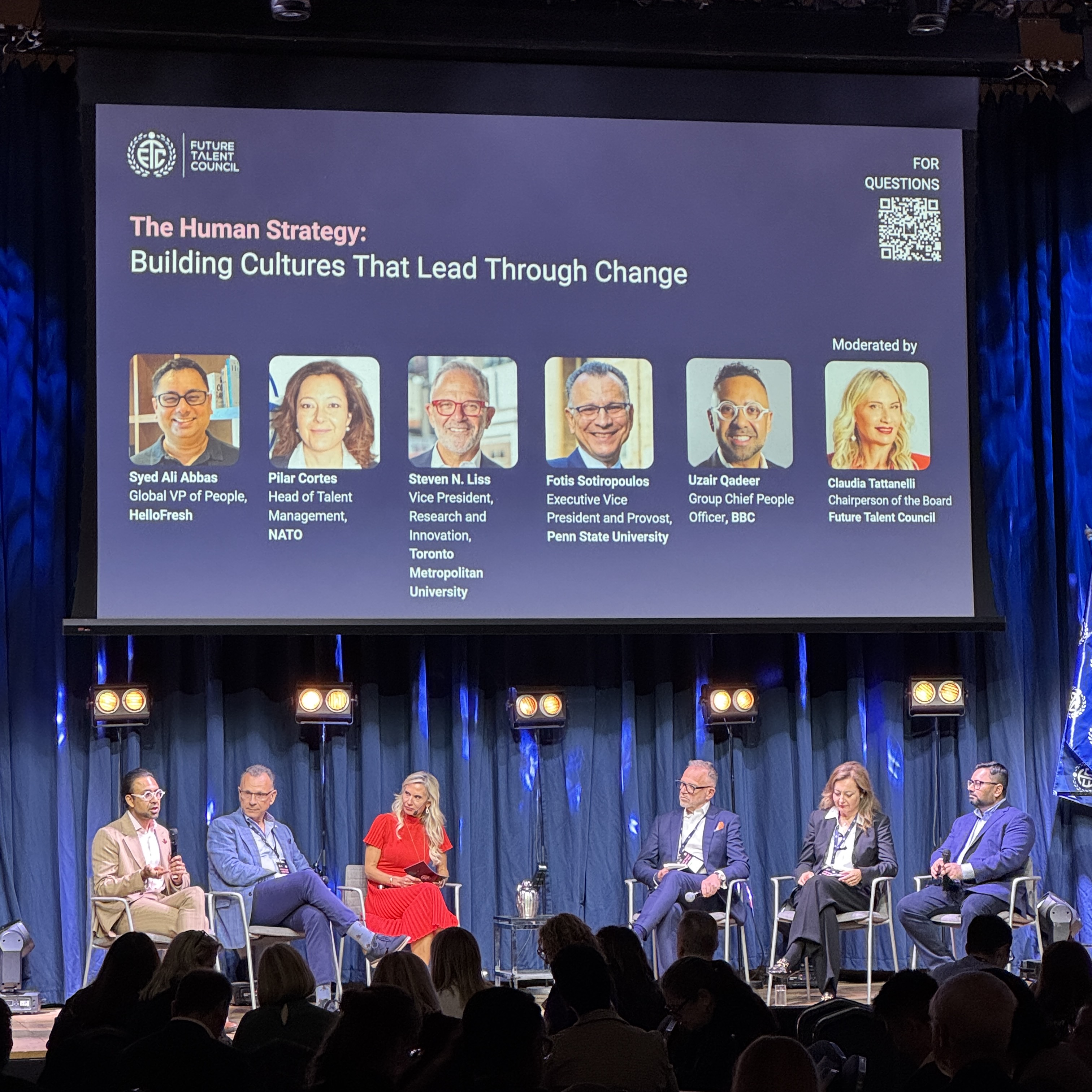
Vivienne Ming's keynote earlier was one person with one sharp argument. This session was the opposite, a six-person panel, and it still landed. Five people who run the people function at wildly different places, plus a moderator, all circling the same question: what holds a company together when everything around it is changing?
The panel was called "The Human Strategy: Building Cultures That Lead Through Change." On stage: Syed Ali Abbas, Global VP of People at HelloFresh. Pilar Cortes, Head of Talent Management at NATO. Steven N. Liss, VP of Research and Innovation at Toronto Metropolitan University. Fotis Sotiropoulos, EVP and Provost at Penn State. Uzair Qadeer, Group Chief People Officer at the BBC. Claudia Tattanelli from the Future Talent Council moderated. A defense alliance, a meal-kit company, a national broadcaster, and two universities. You would expect almost nothing in common. What struck me was how much they agreed.
Culture is the behavior you tolerate
That was the line I wrote down twice. More than one person on the panel landed on the same definition: culture is not your values poster or your code of conduct. Every company has those, and they all read the same. Culture is what you tolerate, what you encourage, and what you reject. If you tolerate underperformance, or harassment, or a weak kind of leadership, that is your culture, whatever the wall says.
Pilar from NATO added the human test for it. How do people's hearts and stomachs feel on a Monday morning? Are they walking in ready to do their best work, or dreading the door? You can read a lot of a company's culture off that one question.
The BBC's framing was that culture is a living thing, not a fixed statement. Your annual plan changes every year. The world around you shifts. A culture you try to freeze for ten years is already dead. So the job is not to write the culture down once and hang it up. It is to keep it alive while everything moves.
You train for the match before the match
Uzair Qadeer's sports analogy was the most useful thing I took from the hour. Teams practice, then they show up to play. They do not show up to the match to practice. Most companies do the opposite with culture and change. They announce a huge transformation, then expect people to work out how to behave in the middle of it.
The BBC ran it the other way around. Before a big wave of change, they built the support first. They hired clinical psychologists into an employee well-being function two years ahead. They put 3,500 team leaders through a year-long program on values, culture, and how to have hard conversations. They ran 300 senior leaders through a five-day leadership program tied to the company's purpose. They reskilled 22,000 people through what they call a skills factory. By the time the hard part arrived, the team leaders were the ones carrying the difficult conversations, not the executives. They had practiced.
Define what you expect from leaders, in writing
Syed Ali Abbas told the story I keep coming back to as a founder. At HelloFresh, the company culture lives in something they call the HelloFresh DNA, and it is baked into everything from hiring to performance reviews to how people leave. But he drew a distinction: leaders are a different group, and they need a different, explicit standard.
So, fairly new in the job, he asked the founder and group CEO to write a leadership memo. Not the company values, those are oxygen, you assume them. This was specific. For the next few years, here are the behaviors we expect from anyone who leads here. They built the leadership frameworks and the training on top of it. Four years on, it is holding.
That part maps straight onto what we think about at Opmore. The thing in the founder's head, the real standard for how a place runs, only becomes real when someone writes it down and builds the system around it. Until then it lives in one person and breaks the moment that person is not in the room.
He had a second point that is easy to miss. Predictability is underrated. People get scared when things are unpredictable, and if your leaders behave consistently day to day, life inside the company gets much easier. Consistency is a feature of culture, not a tax on it.
AI is a human-capital problem, not a tech problem
This was the cleanest answer of the panel, again from HelloFresh. The win with AI is not bolting an agent onto existing work for a small productivity bump. It is rethinking the work so it runs differently.
His example: in HelloFresh production centers, people used to run around the shelves gathering ingredients to pack a meal box, about ten minutes a box. That cap limited how many recipes they could offer. Over three years they combined data science, robotics, and predictive ordering built on fifteen years of customer data. Now the packer stays put and the ingredients come to them. Recipe choice went from 30 to 50 per market up to 100, with one US center trialing 500 a week. Twenty restaurants of choice in your hands instead of two.
Then the line that tied it together. He cited a case from Deloitte's human capital research. A European telecom company treated AI as a technology problem and got a 5% productivity gain. They went back, spent another eighteen months redesigning around people, reskilling, simplifying structures, building for how humans and AI actually work together, and got 30%. His conclusion: AI will not fail because the technology is weak. It fails when you forget it is a people problem.
The universities are moving too
The two academics, Fotis Sotiropoulos at Penn State and Steven Liss at Toronto Metropolitan, made the point that institutions famous for changing slowly are being forced to move fast. Penn State is rolling out AI literacy for everyone, retraining faculty on how to teach and test when every answer is already in the student's pocket, and pushing experiential learning where students solve real, messy problems for credit. Same theme as Ming's talk from earlier in the day: when knowledge is free, the value moves to the people who can do something with it.
Fotis closed with the line that summed up the whole panel. Stop trying to predict the future, it is changing too fast for that. Roll up your sleeves and build it. Be an architect of it. And build a culture with enough resilience and courage that your people can do the same.
What I took from it
Five very different organizations, one shared answer. Culture is the operating system, and in a period of fast change it is the thing you have to build on purpose. Write down what you expect. Train people before the storm, not during it. Treat the tools as a people problem first. None of that is glamorous, and all of it is foundation work. The foundation is the part that does not build itself.
Join the newsletter.
A weekly summary of new insights, plus what's new at Opmore. No spam, just insights.