YC came to Stockholm. Here's what Gustaf Alströmer said to 1,300 founders.
By Mohammed Alsaadi
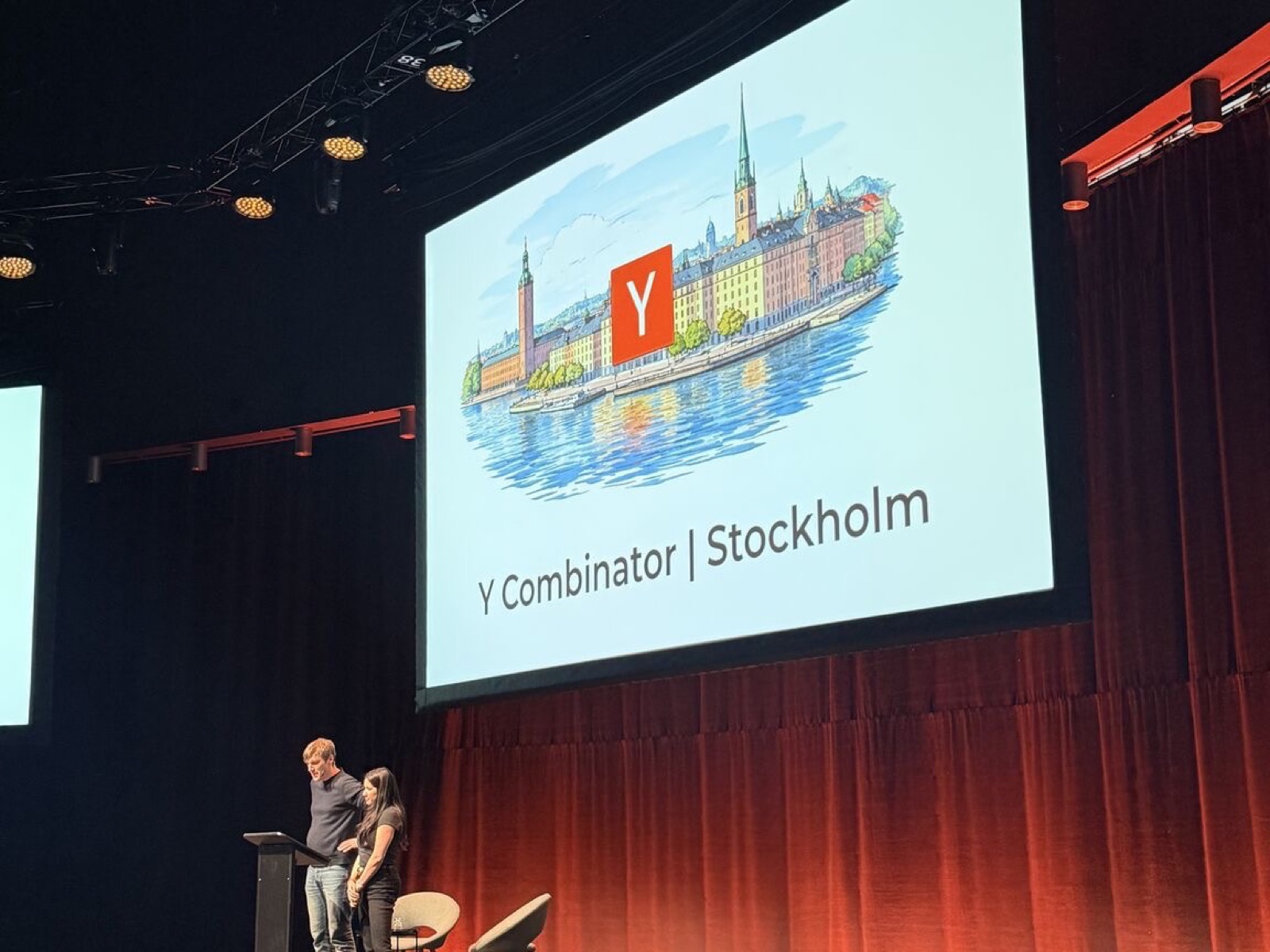
YC came back to Stockholm at the end of April 2026. 4,000 people applied. 1,300 got in. The room was packed and the lineup was stacked: Gustaf Alströmer opening, Max Junestrand from Legora joining him on stage, then Paul Graham giving the keynote.
What follows are the curated highlights from Gustaf's opening talk.
"This is a special place"
Gustaf opened by setting the stakes. Last time YC was in Stockholm, in November 2024, they pulled 200 people. Two years before that, 40. This time, 1,300 in the room and 4,000 applied. The Stockholm tech ecosystem isn't just growing. It's compounding.
"This is the best version of the Stockholm tech ecosystem that ever existed. You're all living in it."
He also issued a warning to protect it:
"Try to figure out what happened the last couple of times when Stockholm was rising, but plateaued and maybe went down. And don't do that again, because this could be the most important thing for Swedish industry for decades to come."
What changed in 18 months
Gustaf walked through the AI timeline since his last Stockholm visit:
- DeepSeek launched and the first real open-source models became a thing
- Cloud Code CLI and Codex CLI launched a month later
- Lovable made vibe coding mainstream
- Manus shipped the first agent flow that ran the full task without supervision
- Cloud Opus came in October
- OpenClaw launched in November
"Normally not that much happens in 18 months. But last year wasn't a normal year."
His take on the shift in mood:
"If you were cautious going into all of this, I think you felt something different last year. The cautious optimism had turned into a real optimism."
What's actually scarce now
This was the line that kept landing:
"Every person in this room can probably acquire the skills you need to build a startup right now. With AI, you're probably more capable than many of the past YC founders were in past batches without these tools."
But:
"What's actually scarce now is the things that AI is not naturally good at. Talking to 50 customers a week, getting rejections from those customers, figuring out distribution, having good taste, having good design sense, being opinionated."
The strategic implication: the bottleneck moved from technical capability to founder agency. Tools have democratized. Judgment, taste, and willingness to do the unscalable work haven't.
Why Gustaf does these tours
He was honest about the agenda:
"We're here to try to convince young, ambitious, technical people to consider starting a startup instead of getting into banking, instead of getting into consulting, getting into big tech. Once you are on that path for too many years, it's quite hard to break out. So we need to meet you early."
His framing on the risk equation:
"For most of my life, entrepreneurship looked risky because regular jobs were safe. This is all about to change. Getting a regular job will soon be as risky as starting a new company. Not because regular jobs are going away. They are going to change, but not go away."
Six pieces of advice for ambitious technical people
Gustaf's playbook for someone considering this path:
- Work at a great startup, not too long. "Stay long enough to learn, but not long enough to get comfortable."
- Build side projects. Solve problems you have today. "That's roughly how Legora and Lovable started."
- Get comfortable with Cloud Code, Codex, OpenClaw. "This is table stakes and it's going to change your life."
- Choose your co-founder carefully. "When you think of a potential co-founder, you shouldn't think of who might say yes, but who's the best person. Maybe the best person has been waiting for you to come and ask them."
- Don't study entrepreneurship in school. "It doesn't work. The only way to study entrepreneurship is to actually do it."
- Just start. "Most great founders shipped many things before they ended up building the actual company that they became famous for."
What founders are actually building now
Gustaf described two patterns YC is seeing in current batches.
AI agents replacing workflows and entire job functions. Not copilots, not assistants. AI accountants, AI lawyers, AI recruiters, AI sales engineers, plus the infrastructure to support them: payment rails for agents, identity systems, security guardrails, monitoring tools.
The shift to the physical world. More robotics, defense, manufacturing, hardware, and biotech companies than YC has funded in years. Autonomous drones, robots that build solar farms, AI for drug manufacturing. The ambition has gone up, and founders are using software-startup techniques to attack hardware-heavy domains.
"Founders are picking a specific domain, they're going deep, and they're building something that actually does the work, not just helps someone do the work."
The data point that landed hardest
Gustaf closed with a stat that was hard to argue with:
"Winter 26 was the fastest growing batch we've ever had. The companies grew 14% weekly revenue throughout the batch. We had 14 companies hitting $1 million in ARR at demo day. A year before, that number was five. Almost tripled."
His attribution:
"The founders are great but LLMs is the reason why the products are better."
Why this matters
Gustaf's frame is that we're in a window. The AI tools are real. The capability gap has narrowed. The thing left to do is the unscalable work that AI can't do for you: customer conversations, distribution, taste, opinions. The founders who pick a specific domain, go deep, and build something that does the work (not just helps people do the work) are the ones in position to win the next decade.
If that's the bet, the question worth asking is whether you're spending your time on something that compounds. Gustaf's whole talk was an argument that this is the best year on record to be a technical, ambitious person who picks the harder path now while the window is open.
The 1,300 people in the room came because they're already considering it. The 4,000 who applied went home with the same arithmetic.
Join the newsletter.
A weekly summary of new insights, plus what's new at Opmore. No spam, just insights.