Max Junestrand on building Legora to €100M ARR (in conversation with Gustaf)
By Mohammed Alsaadi
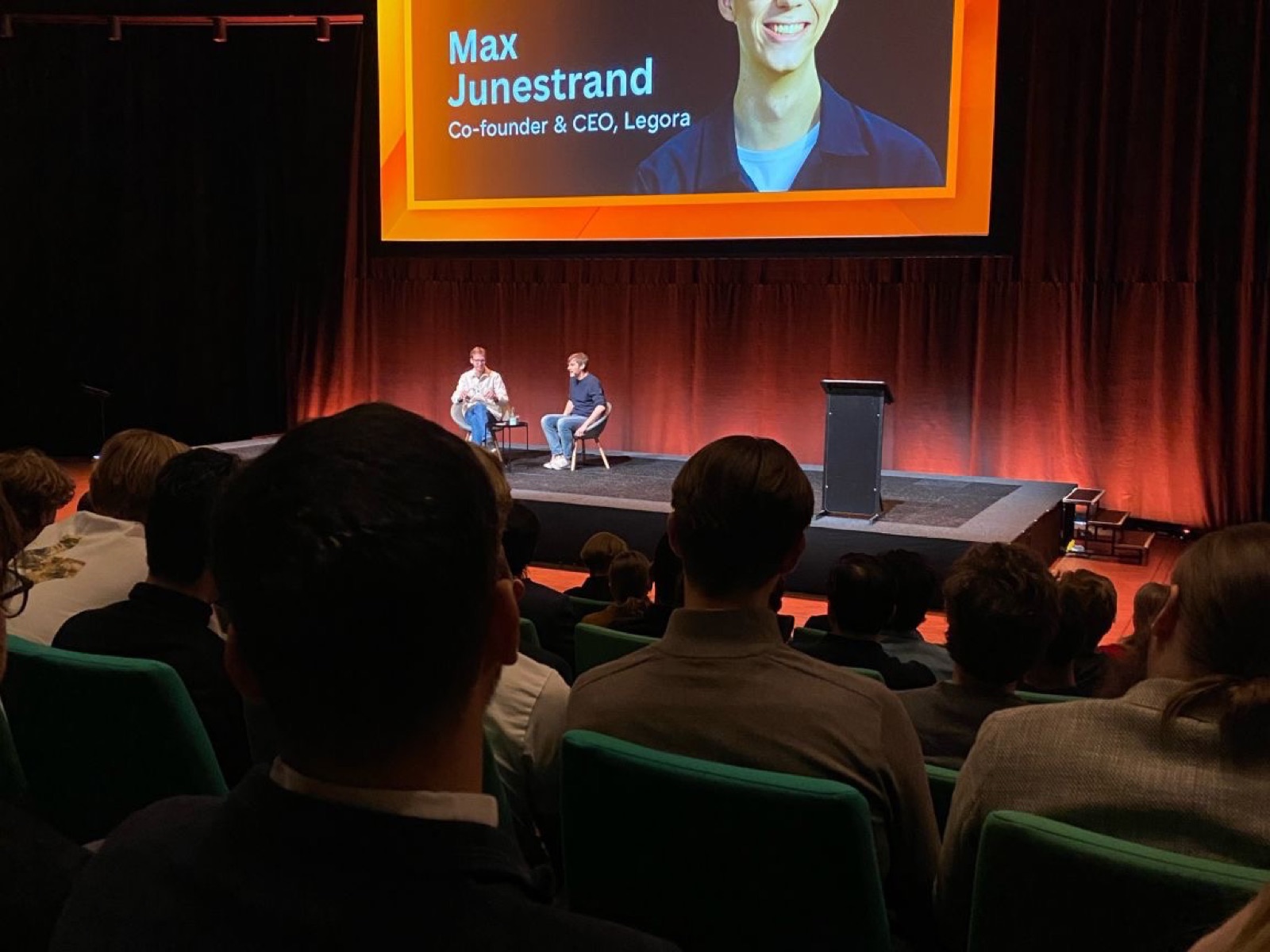
When Gustaf Alströmer introduced Max Junestrand as "the coolest, hottest company in Sweden right now" at YC Stockholm, it wasn't hyperbole. Legora is at €100M ARR, around 500 employees, and growing into a global category leader for AI in legal. The conversation they had on stage covered the playbook that got them there. Highlights below.
On the Jude Law campaign
Max opened with the story of how Legora got Jude Law to front their ad campaign.
"Has anybody ever looked at advertisement or marketing for a legal technology company and said that's sexy? It is the most boring, the most bland. It makes automotive parts look hot."
After "at least one bottle of wine in the office," they pitched Jude Law. He said no. They chased him for six months. Finally got a call. Showed him their customer testimonial Slack channel ("Customer Love"). He was in.
"He said, 'I want to bring my own screenwriter. I want to bring my own cinematographer.' And he ended up getting a Saturday Night Live scripter and the cinematographer of Oppenheimer."
The campaign worked. They got a lead from a "somebody's mom saw the ad and forwarded it" loop. Marketing-engineering at work.
Why he didn't go to McKinsey
Max did a McKinsey internship and thought it was the path:
"I thought that was the Mount Olympus of what you could do. And I went there and I realized how stupid a lot of the people were."
The decision to start something:
"I had optionality. I said, we're going to work on this for a summer. If it turns to something, then let's go for it."
When Legora got into YC, he called McKinsey to say he wasn't coming back. He wasn't the only one:
"There's a group of 10 to 15 people at Legora who had offers at McKinsey. Even Jake, our CTO, kept the offer for six years. Then they started calling, 'are you ever coming back?'"
The YC hot-swap
When Legora got into YC, they made an unconventional call. Instead of moving the founders to San Francisco for the batch, Max went to YC and the rest of the team came back to Stockholm to keep selling.
"The team that was in the US shipping in YC came back to take care of the customers because I had to go to YC to do the fundraise. This is an underappreciated part of YC for first-time founders. There's a lot of investor reach and signaling value to be in YC."
While in YC, Max ran a Stockholm sales workshop via 1 AM calls:
"I was running around Stockholm with my little briefcase. It was like a real gulag. We worked so hard."
Building pipeline before YC
Max's contrarian point on YC's reputation for "explosive growth":
"I had built a lot of that pipeline going into YC. We have roughly three to four month sales cycles. So a lot of the revenue we hit between January and March, I started building the pipeline for in October."
The numbers: Legora went from around €20K in revenue to €800K during the batch.
How they landed Mannheimer Svartling in 30 minutes
Max needed social proof to break in. He targeted Jan Dänestam, CEO of the biggest law firm in the Nordics. Got 30 minutes. Walked out with a deal.
"When it matters, you're not allowed to miss. I came prepared. I wrote a two-page memo on the guy. I knew everything that he had said publicly for the last 10 years."
He found a 2019 quote where Jan said AI was "more artificial than intelligent." Max led with it:
"I told Jan, 'AI used to be more artificial than intelligent, but now it's different. Trust me.' And he was like, 'wow, I totally agree.'"
After 30 minutes, Jan stood up and said: "We're going to work together and you're going to move into my firm and help us be the best at AI in the world."
On competing with Harvey ($25M and GPT-4 access)
Legora started in spring 2023 with €50,000. Their main US competitor, Harvey, had $25M from OpenAI and Sequoia and a year of GPT-4 access before the public release. Legora bet differently:
"They were enormously cocky. They focused all of their energy on building fine-tuned models for the first two years. We said that's all going to depreciate and we can work with any model. So let's focus on the application layer."
The competitive intensity became culture:
"We see ourselves as professional swimmers who look down at the black line in the swimming pool. So when the competition is looking sideways and getting slowed down by looking at us, we're looking at the line."
The "Get Big Fast" doctrine:
"We have a saying, GBF, get big fast. We should all know that this day is coming, and if you're building sand castles, the wave is going to screw you. So you really need to build the things that continuously get better as the models get better."
Sales philosophy
Max's playbook for enterprise sales in regulated industries:
"The way I approach any sales conversation is, what can I do for you? It's not about what they can do for you."
On discovery vs pitching:
"Professionals in sales are very good at discovery and listening and learning about the problem rather than pitching your solution. You spend as much time in discovery to learn how to position your tool to be exciting for them."
On selling more than the product:
"You are equally selling the product as you are selling the opportunity to work with your company. Everyone wants to be part of the cool club. Lawyers want to be part of the next generation of technology. They don't want to be stuck in a Word from 1986."
On social proof economics:
"I would discount our product almost down to zero, as long as they did a marketing announcement with us."
The €2M deal that almost was free
Max ran a three-month A/B between Legora and Harvey at a major UK firm. Legora won. The managing partner called Harvey to break the news. Harvey countered with three years of free product. The partner called Max:
"He said, 'You guys are quoting us six million dollars and they're giving it to us for free. I can't take this to the partnership.' I just went, 'I have seen your watch. I know you're not a man who picks on price.' Then I said, 'I want to do business with you. We're spending millions of dollars on these large language models. So if that's okay with you, I'd love to go down to two million.' And he went, 'okay, let's do that.' That's how we went from a $0 deal to a two million dollar deal."
Imposter syndrome plus extreme conviction
Asked how he reconciles those two traits:
"I feel imposter syndrome every day. I look out over our company and I'm like, 'how did I trick all these really smart people to come work with me?' But at the same time, you got to be like, 'we're the best company in the world.' And from time to time, I genuinely believe that."
The story behind a 9-0 partnership vote:
"We ran a big pilot at a US law firm. Us versus Harvey. It came down 34% preferred Legora, 33% preferred Harvey, 33% didn't care. They said, 'we'll take Max and Winston (Harvey's CEO) and have them pitch our partner committee.' We came out 9 to 0 in favor."
Where Legora is today
Max's frame on the current moment:
"We've been about to hit base camp and now the real climb is about to begin. We have proven it to ourselves that we could do this part of the journey, but nobody is content."
On agentic capabilities:
"We can build really powerful proactive agents now. Instead of opening your email inbox at 5 AM and it's super messy, with 500 emails from yesterday, it will have done work on your behalf. We're moving into a world where one of our main bottlenecks is evals for end-to-end work products."
On model commoditization risk:
"What's defensible in your business assuming a continuous either exponential or linear increase in the model intelligence? If we all think about a world where the model is so good that it on the fly writes all the code, gets all the data, figures out everything to solve a task, then we should all go have a piña colada. So I don't naturally think that's going to be the end state. We think a lot about what are the inputs and outputs, what is the proprietary data, what are the workflow modes, what is the behavior we're teaching our users."
Why this matters
Max's playbook isn't just for legal AI. The structure repeats across vertical AI:
- Pick a specific industry, go deep on the workflow
- Get a flagship customer with social proof, even if the early product is rough
- Bet on the application layer over fine-tuning
- Out-execute the well-funded competitor through speed and intensity
- Build the customer relationship as much as the product
The line that landed hardest:
"When others are opportunistic, we will dig into the ground and keep grinding it out."
That's the answer to "how did you out-execute the competitor with 50x your funding."
Join the newsletter.
A weekly summary of new insights, plus what's new at Opmore. No spam, just insights.