I was on a call recently with a Nordic SaaS founder doing about €1.2M ARR. He'd had two acquisition conversations in the previous six months. The first valued his business at 3.8x EBITDA. The second came in at 4.2x. Both buyers liked the product, the customers, the growth. Both said the same thing about the multiple: "you close every meaningful deal yourself."
He thought he was getting a fair offer. He wasn't. He was getting the founder-dependent discount.
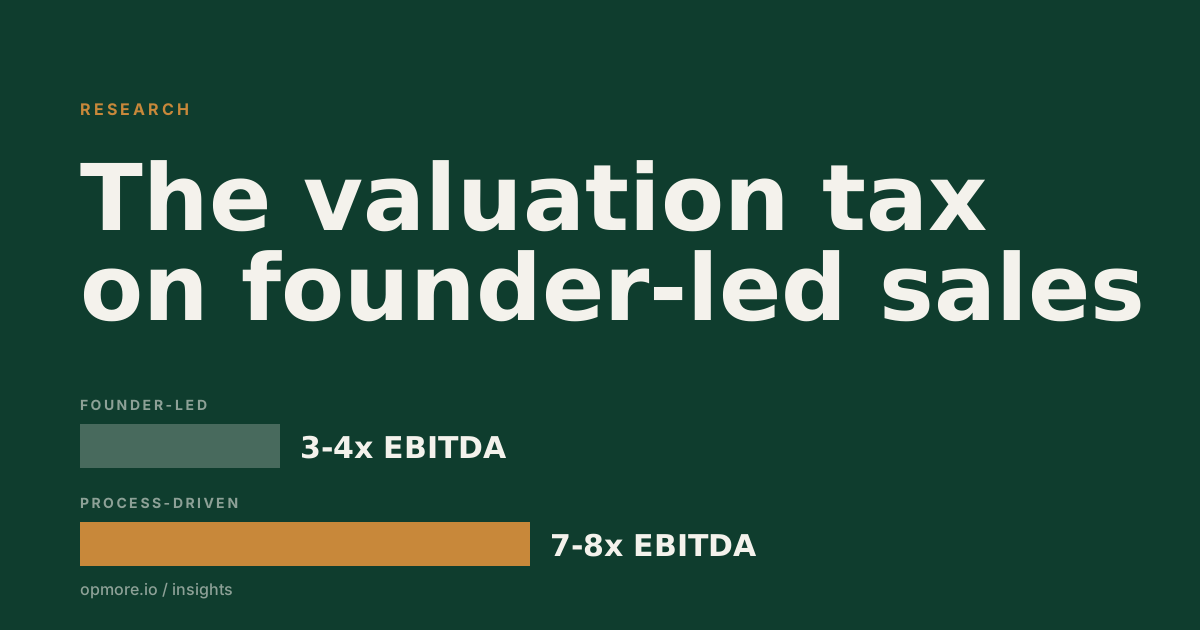
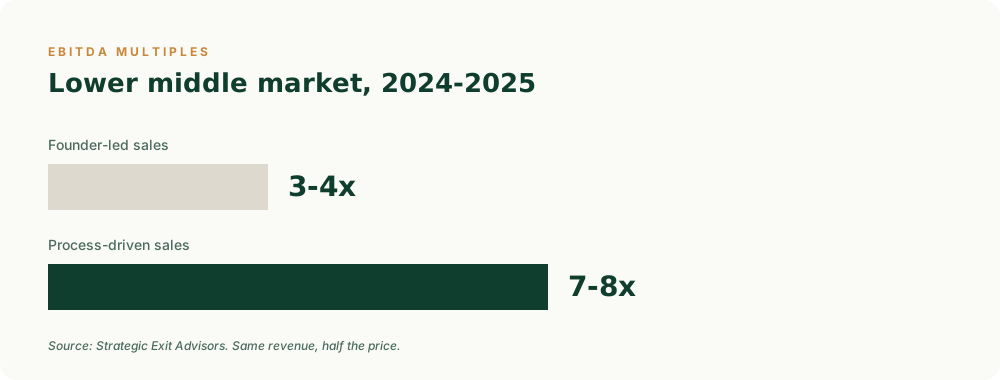
Across both sides of the Atlantic, the pattern is consistent. A SaaS or tech-enabled services business with systematized sales sells for 7 to 8x EBITDA in the lower middle market. A business where the founder is still the rainmaker sells for 3 to 4x. Same revenue. Same growth rate. Half the price. (Source: Strategic Exit Advisors.)
The buyer's reasoning is simple. They aren't buying a company. They're buying its future cash flow. If that cash flow lives in one person who's about to step out, it's at risk. They price the risk in.
This is the valuation tax on founder-led sales. It's not avoidable on the buyer's side. They will price it in. It's only avoidable on yours, by building the foundation before they have a chance to find the gap.
The number is real
The Value Builder System has analyzed more than 80,000 small and mid-market businesses against a "sellability score" that measures, among other things, owner dependency. The data is brutal in its consistency: average-scoring businesses (around 59 out of 100) get acquisition offers averaging 3.5x pre-tax profit. Businesses scoring 90 or higher get offers averaging 7.1x. (Source: Value Builder System, Apex Business Advisors.)
That's a 103% premium for being transferable. Doubling your transferability does more for your exit than doubling your revenue.
In the wider PE market, the same arbitrage shows up structurally. Bain & Company's 2024 Global Private Equity Report describes "buy-and-build" as the dominant strategy: PE firms acquire owner-reliant "bolt-ons" at 4 to 6x EBITDA, integrate them into platforms trading at 10 to 15x, and capture the spread. (Source: Bain & Company.)
A €2M EBITDA bolt-on bought for €10M (5x) becomes worth €26M (13x) the moment it's absorbed into a real platform. €16M of value created without one new euro of revenue. Pure structural transformation.
That €16M is the prize buyers are competing for. The discount on your end is what they bid against.
What buyers actually look for
This isn't a vibe check. It's a checklist that shows up in nearly every diligence pack. From Diligent's standard M&A diligence framework to the UK's commercial-due-diligence "five pillars" approach, the items recur:
- A documented sales process. Stages from lead to close. Qualification criteria. Playbooks for objection handling.
- A CRM that actually reflects the pipeline. Buyers don't trust forecasts that live in the founder's head.
- More than one person who can close. If every meaningful deal goes through you, that's a single point of failure.
- Customer relationships held by the company. Not by one person's phone. Not by one person's LinkedIn.
- Forecasts grounded in data. Not gut feel.
- Onboarding for new sales hires. A document a new rep can read on day one and be productive on day 30.
The line M&A advisors use, almost word for word: if marketing and sales live only in your head, you're the risk.
This is what buyers test for. They'll ask to talk to your top three customers and listen for whether they say "I bought because of [founder name]" or "I bought because of [company]." They'll review your CRM and check whether the forecast methodology is repeatable or invented every quarter. They'll ask new sales hires (if you have any) what their first 30 days looked like.
If the answers point to one person, the multiple gets cut. Whether they say it that bluntly or not.
The discount shows up worse than you'd expect
Most founders expect the cost to show up as a lower headline price. It often shows up worse than that, in the structure of the deal.
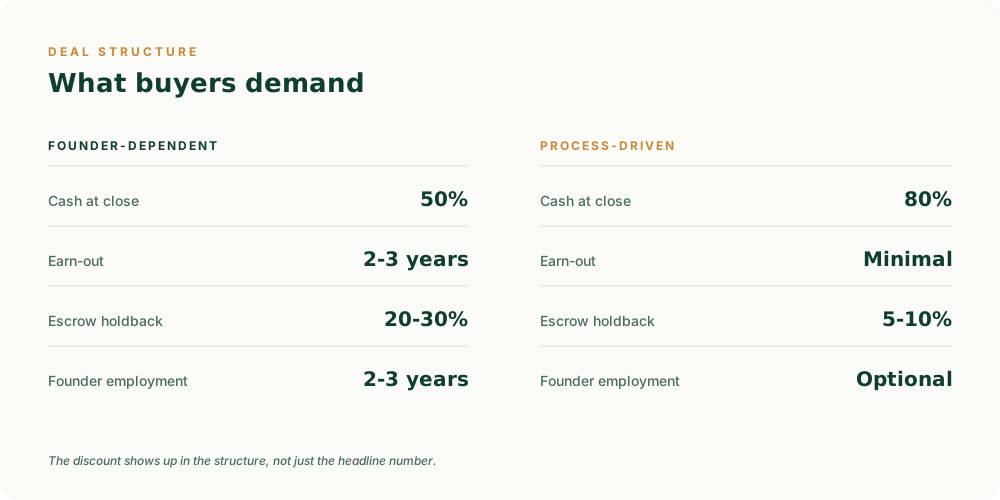
For a founder-dependent business, buyers typically demand:
- Earn-outs of 2 to 3 years post-close, where you only get the full payout if revenue continues with you involved
- Larger escrow holdbacks, sometimes 20 to 30% of the price
- Lower cash at close, around 50% versus 80% for systematized deals
- Longer employment agreements, tying you to the business for 2 to 3 years
You sell for less, and the part you do sell for is contingent on you not leaving. You're effectively re-earning your own exit. The seller's actual outcome is often 30 to 40% lower than the headline price, once earn-out shortfall, escrow leakage, and time-value-of-money are factored in.
In worst cases, buyers walk. Strategic acquirers especially. They'd rather not inherit a single point of failure. They have their own management bench. PE firms might still bid, but they narrow the bidding field, which kills competitive tension and drops the price further. (Source: William Buck Australia.)
What changes when you fix it
The case studies are consistent. Founders who step back 3 to 5 years before sale, install a real management layer, and prove the sales engine runs without them, see acquisitions become competitive. More bidders. Higher prices. Cleaner terms.
One investment banker quoted in the M&A literature put it bluntly: when a company comes to market with a capable team that will stay, "it broadens the market dramatically." More bidders means more competitive pressure. Competitive pressure means higher offers and cleaner terms.
The math is the same in reverse. Fewer bidders means the buyer dictates the price. A founder-dependent business in 2025 typically attracts 2 to 4 serious bidders. A process-driven one of equivalent size attracts 8 to 12. (Source: Brentwood Growth.)
How OPTICS maps to what buyers test for
OPTICS is built around exactly the six pillars buyers test for in diligence. That isn't a coincidence. The framework was designed for the founder's day-to-day pain ("I'm the only one who can sell"), but the same six pillars are what acquirers verify before writing a check.
- O · Offering. Buyers test whether your value proposition is reproducible, or whether it only works because you said it.
- P · Prospecting. Whether you have multiple working channels, or one founder-driven channel that runs on personal network.
- T · Targeting. Whether you have an ICP a new rep could qualify against, or a "we take whoever shows up" pipeline.
- I · Insights. Whether you have a documented buying-logic understanding, or jump straight to demos.
- C · Conversion. Whether you have a repeatable approach a new salesperson could execute, or improvise every deal.
- S · Scalability. Whether the sales motion survives you taking a two-week vacation.
The diligence-checklist version of this is the same questions, in suit-and-tie language. The fix is the same in both worlds. Build the system. Document the process. Make yourself replaceable in the critical path.
If you want to see where your foundation actually is, take the free OPTICS test. Ten minutes. No pitch. Just clarity on which of the six pillars are working and which are still living in your head.
The take
You can build the foundation now while you have time, or let the buyer find the gap during diligence and use it to negotiate you down. Every surprise in due diligence is a negotiating point for the other side. A sales process that lives only in your head is the biggest surprise you can hand them.
The question to run on yourself is simple. If you disappeared for two weeks tomorrow, would the next salesperson on your team be able to read a document and replicate what you do?
If not, the foundation isn't there yet. Build it before someone else gets to use it as a discount.
FAQ
How much can founder-dependency reduce my valuation? Documented discounts range from 30 to 50% versus comparable businesses with systematized sales. The discount shows up in the headline multiple (3 to 4x EBITDA versus 7 to 8x) and in the deal structure (longer earn-outs, lower cash at close, larger escrow).
At what stage should I start systematizing? Most M&A advisors recommend 3 to 5 years before a planned exit. The earlier you start, the cleaner the diligence narrative. If you're already in market, fixing what you can in 6 months still helps, but you'll likely take some discount.
What's the difference between SDE and EBITDA multiples, and why does it matter? SDE (Seller's Discretionary Earnings) is the metric buyers use for owner-operated businesses. It's structurally lower than EBITDA. When a business stops being owner-dependent, the valuation methodology shifts to EBITDA multiples, which are higher. This shift alone often roughly doubles the value, before any other change.
Will hiring a salesperson fix the problem? Not on its own. If you hire a salesperson but the sales process still lives only in your head, the new rep can't replicate it. The 80% first-sales-hire failure rate that academics and operators cite comes from this exact gap. Build the system first, then hire into it.
What does a buyer actually verify in diligence? They'll review CRM data quality, talk to your top customers about why they bought, check whether forecasts are based on data or judgment, ask new hires about their onboarding, and look at whether your top sales people are different from the founder.
Sources
- Strategic Exit Advisors. Founder Dependency: The Hidden Valuation Killer
- Value Builder System / Ryan C. Winter. Sellability Score data
- Apex Business Advisors. The 8 Components of the Sellability Score
- Bain & Company. Global Private Equity Report 2024
- William Buck. Assessing key person risk on business valuation
- Brentwood Growth. The Hidden Cost of Owner Dependency
Join the newsletter.
A weekly summary of new insights, plus what's new at Opmore. No spam, just insights.