Why Process-Driven Companies Sell for Twice as Much
By Mohammed Alsaadi
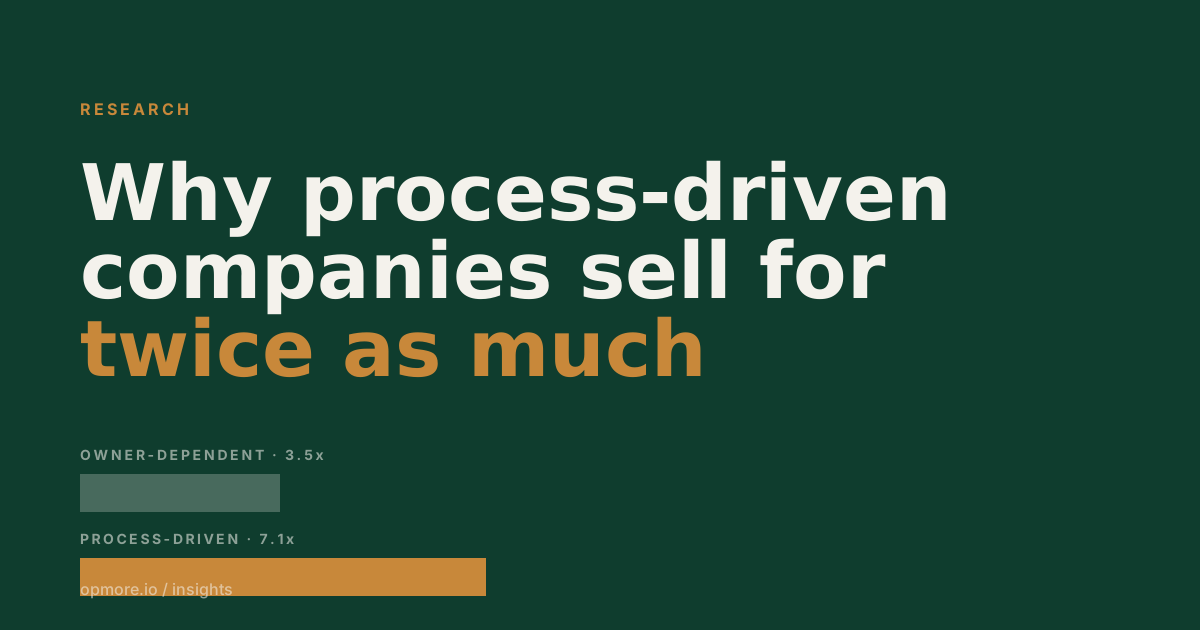
Two companies. Same revenue. Same product. Same growth rate. One sells for 3.5x pre-tax profit. The other sells for 7.1x. The difference isn't the business. It's whether the business runs on the founder or on a system.
This isn't a marginal effect. The market has split into two asset classes: owner-dependent businesses, priced as a high-risk income stream, and process-driven ones, priced as a transferable platform. The premium for moving from the first class to the second is roughly 100%.
Doubling your transferability doubles your exit. Doubling your revenue does the same, but the first one is faster, cheaper, and almost entirely under your control.
Personal goodwill vs enterprise goodwill
The legal and financial framing is older than the SaaS market.
Personal goodwill belongs to a person. Their reputation, network, judgment, relationships. It walks out the door when they do.
Enterprise goodwill belongs to the company. Brand, codebase, recurring contracts, documented processes, a team that knows how to operate. It survives a founder leaving.
Buyers pay a premium for enterprise goodwill because it's the asset they're actually acquiring. Personal goodwill is something they're hoping you leave behind. Mostly, you can't.
For owner-dependent companies, the valuation methodology itself shifts. Instead of being priced on enterprise multiples (EV/EBITDA), they get priced on Seller's Discretionary Earnings (SDE) multiples, which are structurally lower. You drop a tier just by how the math gets set up.
| Asset class | Metric | Owner-dependent | Process-driven | Premium |
|---|---|---|---|---|
| SaaS | Revenue multiple | 2-4x ARR | 6-10x ARR | +150-200% |
| Agency / services | EBITDA multiple | 2.5-4x | 6-8x | +100% |
| UK SME | EBITDA multiple | 3.1x (micro) | 8.5x (mid-market) | +174% |
| Across asset classes | Pre-tax profit (Value Builder) | 3.5x | 7.1x | +103% |
Sources: CLFI UK 2025, PitchBook, Value Builder System, Strategic Exit Advisors.
The math behind the discount
The discount rate buyers use to value your future cash flows includes a Company-Specific Risk Premium. Owner dependency is the single biggest variable inside that premium.
A systematized business carries a CSRP of 2 to 4%. An owner-dependent one carries 10 to 20% or higher. (Source: Mark S. Gottlieb CPA.)
A 5-point jump in the discount rate, holding revenue flat, can cut a business's value by 30% or more. That's where the empirical 30 to 50% discounts in the market come from. The math and the deals match.
Why PE pays the premium
PE firms don't pay 12x EBITDA for systematized businesses out of generosity. They're arbitrageurs. They buy bolt-ons (owner-reliant, smaller firms) at 4 to 6x EBITDA, integrate them into platforms trading at 10 to 15x, and capture the spread. (Source: Bain & Company.)
A €2M EBITDA bolt-on bought for €10M (5x) becomes worth €26M (13x) the moment it's absorbed into a real platform. €16M of value created without a single new euro of revenue. Pure structural transformation.
Bain's 2024 data also clarifies what the premium actually requires: deals that relied solely on multiple arbitrage (financial engineering) generated a 1.4x MOIC. Deals that combined arbitrage with operational improvements (systematization, organic growth) generated 2.2x. The 2025 market is too efficient to reward simple aggregation. The real premium is paid only when the bolt-on assets are genuinely transformed into a process-driven whole.
This is half the M&A activity in digital services right now. It's also why PE firms walk away from anything they can't transform. If you can't be processed, you're not interesting.
The math you can run on yourself
The simplest demonstration of the premium is the GM hire.
You're an owner-operator pulling €1M a year out of the business. Buyers value owner-operator businesses at SDE multiples, around 3x. The business is worth €3M.
Now you hire a GM at €200K. Your profit drops to €800K. But the business is no longer dependent on you, so it gets valued at EBITDA multiples, around 7x. The business is worth €5.6M.
You took a €200K hit on profit and created €2.6M in equity value.
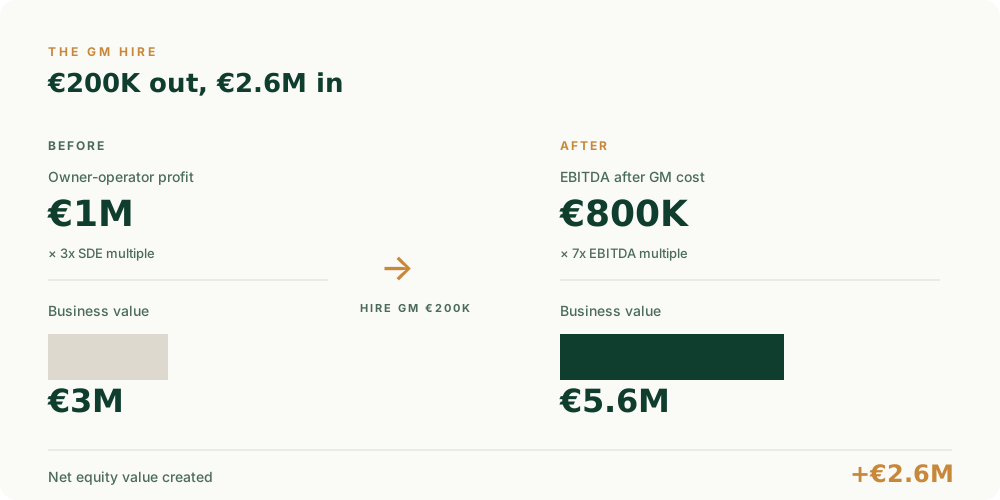
This isn't a trick. It's the actual structure of how private companies are priced. The market pays a higher multiple for an asset than for a job. Hiring yourself out of the critical path is the highest-ROI move you can make on your own valuation.
The same logic applies at smaller scales. A founder pulling €400K a year at 3x SDE is sitting on a €1.2M business. Hire a Head of Sales at €120K. €280K EBITDA at 7x = €1.96M. Net created: €760K, on a €120K annual cost. The premium scales with revenue.
Geography matters
The base rate varies by region.
In the US, PE buyers paid a median 12.8x EV/EBITDA in 2025. SaaS revenue multiples held around 6.1x ARR. Owner-dependent firms still get priced down, but the US market tolerates more operational immaturity if the growth is there. American buyers (especially VC and growth equity) believe they can fix the dependency after the deal closes. (Source: PitchBook, First Page Sage.)
In the UK, the multiple curve is harsher and more size-dependent. Micro-SMEs sell for 3.1x. Lower mid-market hits 7.1x. UK founders who grow EBITDA from £200K to £1M don't just get 5x more value, they get 8.4x more, because the multiple itself expands as the business scales. (Source: CLFI UK 2025.)
In the DACH region, the average SME multiple sits around 5.55x because the Mittelstand culture already builds documented processes and middle management. Even smaller German companies tend to be less founder-centric than their UK or US counterparts.
Southern Europe trades at a discount, partly because family-business dynamics make key-person risk sharper. PE buyers love it for inventory, but they pay less. (Source: Dealsuite.)
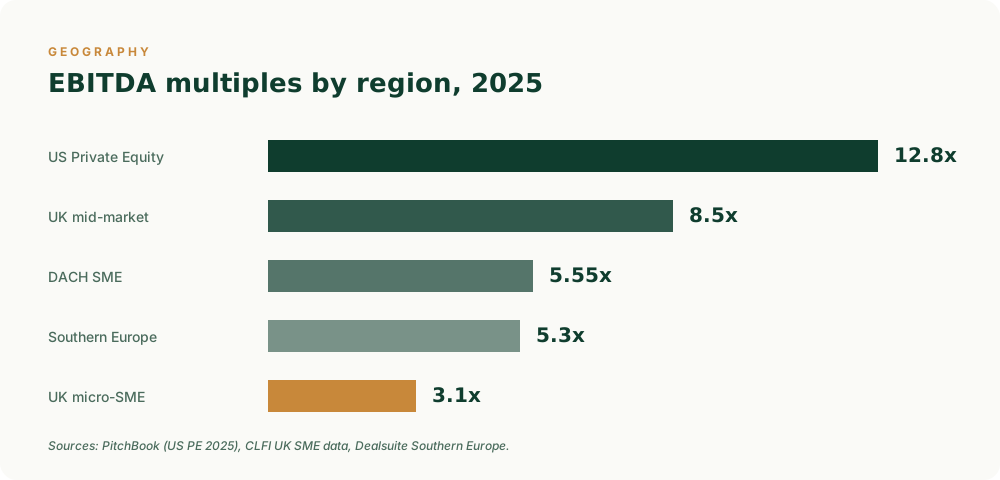
For a Nordic SaaS or services founder, the most relevant benchmark is the UK and DACH spread. The base multiple you'll attract depends as much on which buyer pool you sell into as on your operating performance.
The Switzerland Structure
The Value Builder methodology calls the target state the "Switzerland Structure": independence and neutrality. (Source: Apex Business Advisors.)
- No customer is more than 15% of revenue
- No employee, founder included, is indispensable
- Multiple sourcing options exist for critical inputs
This is what buyers are checking for, whether or not they use the term.
How this maps to OPTICS
The Switzerland Structure is the buyer's frame. The operational frame, for a founder still building, is OPTICS.
OPTICS is six pillars: Offering, Prospecting, Targeting, Insights, Conversion, Scalability. The "S" pillar (Scalability) is the same question buyers ask: can the sales motion run without you in every deal? The other five pillars are what make Scalability possible.
A business with all six pillars working is, by definition, no longer founder-dependent. The valuation re-rates from SDE-multiple to EBITDA-multiple. The buyer pool widens. The deal terms get cleaner. The same operational work that lets you take a two-week vacation is the same work that doubles your exit.
If you want to see where your business is on each pillar, take the free OPTICS test. Ten minutes, no pitch.
The take
The market has decided that systematization is worth roughly the same as doubling revenue. You can chase growth, or you can engineer yourself out of the critical path. The second one is usually faster, usually cheaper, and almost entirely under your control in a way growth isn't.
If you're 24 months from a raise or an exit, the question isn't "how do I grow faster?" It's "what would have to be true for this business to operate without me?"
That's the actual roadmap.
FAQ
What's the difference between owner-dependent and process-driven valuations? Owner-dependent businesses are priced on Seller's Discretionary Earnings (SDE) multiples, typically 3 to 4x. Process-driven businesses are priced on EBITDA multiples, typically 7 to 8x in the lower middle market. The shift in methodology alone roughly doubles the valuation.
How does hiring a GM actually create equity value? Hiring a GM lowers profit (because of the salary) but lifts the multiple buyers will pay (because the business is no longer founder-dependent). The math: €1M profit at 3x = €3M. Hire a €200K GM. €800K EBITDA at 7x = €5.6M. Net €2.6M in equity value created, for a €200K annual cost.
Does growth matter more than systematization? Both matter, but the math says systematization is the higher-ROI lever for most founders. Doubling revenue doubles your exit. Doubling your sellability score (the standard measure of transferability) also doubles your exit. The systematization work is usually faster and cheaper to execute.
What's a Company-Specific Risk Premium and why does it matter? It's the part of the buyer's discount rate that captures risks specific to your business (versus market-wide risks). Owner dependency is the single biggest variable inside it. A high CSRP makes future cash flows worth less in present-value terms, which is what a "lower multiple" actually means.
My business is in Sweden, Finland, Norway or Denmark. Which benchmark should I use? For Nordic SaaS and tech-enabled services businesses, the relevant benchmark is the UK and DACH spread. Most acquirers will be UK PE firms, DACH strategics, or US firms doing transatlantic add-ons. UK and DACH multiples (5.5 to 8.5x EBITDA depending on size and systematization) are the closest comparable.
How long does it take to fix founder-dependency before exit? Most M&A advisors recommend 3 to 5 years to fully transition. 12 to 18 months is the minimum to show meaningful evidence of a working sales system to buyers. Less than 12 months and the diligence narrative falls apart.
Sources
- Strategic Exit Advisors. Founder Dependency: The Hidden Valuation Killer
- Value Builder System. Sellability Score data
- Apex Business Advisors. 8 Components of the Sellability Score
- Bain & Company. Global Private Equity Report 2024
- PitchBook. Middle-market PE offers fertile ground for multiple arbitrage
- CLFI. EBITDA Multiples by Industry UK 2025
- Dealsuite. Southern European M&A Monitor
- First Page Sage. SaaS Valuation Multiples 2025
- Mark S. Gottlieb CPA. Unlocking the Key Person Risk in Business Valuation
Join the newsletter.
A weekly summary of new insights, plus what's new at Opmore. No spam, just insights.